
By Fund The People Editorial Team. Updated 7 October 2026.
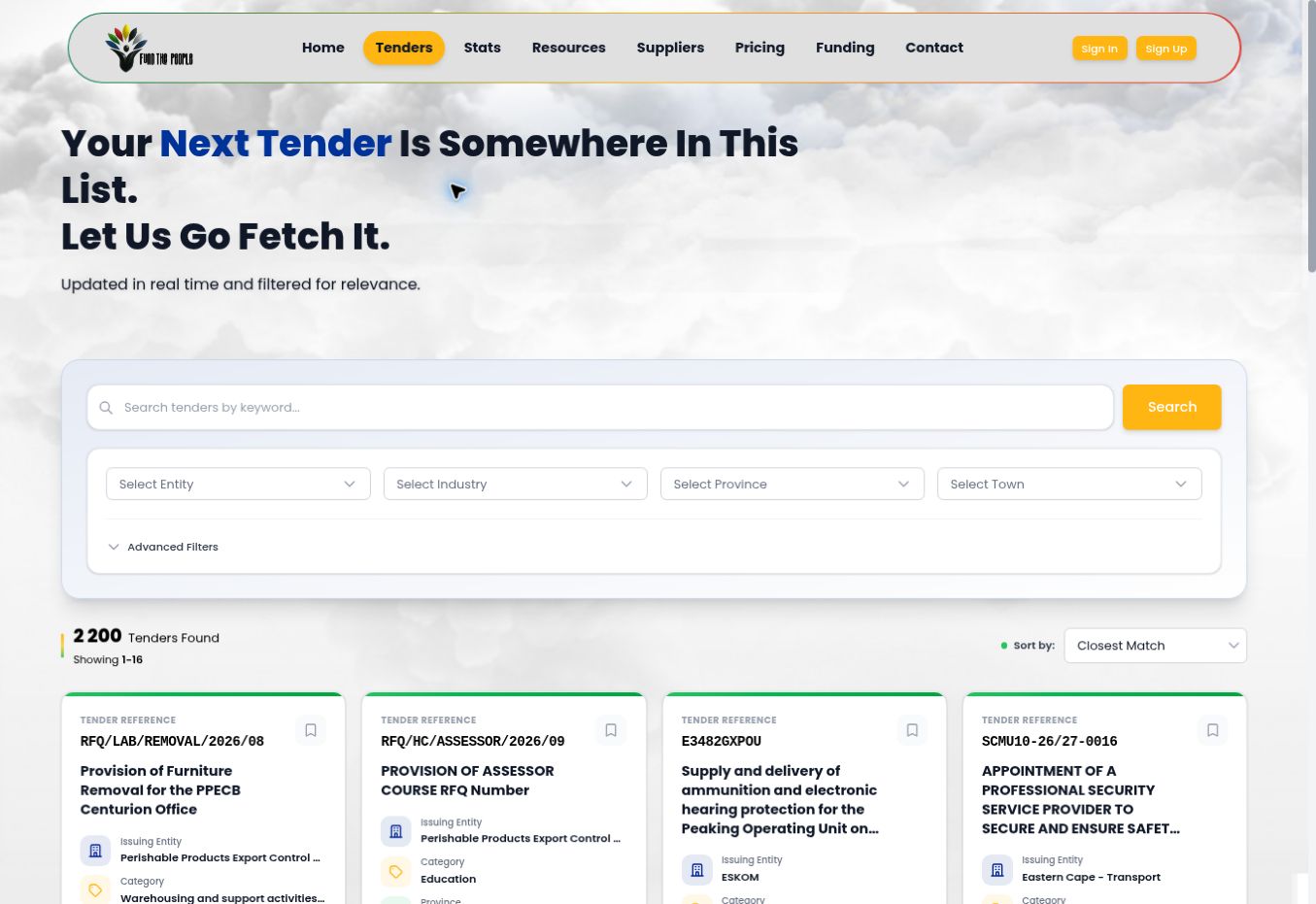
Start your search for tenders in South Africa on the Fund The People Tender Portal, with real-time tender listings from major South African municipalities and public entities. Use this guide to track addenda, briefings and closing dates as you prepare your bid. Once awarded, our own Purchase Order Funding Solutions offer R250,000–R8,000,000+, with funding approval within 48 hours for complete qualifying applications. Fund The People gives you a practical route from opportunity discovery to an awarded-work funding enquiry.
Build an authoritative document register
Issuer and reference
Record the buyer, official tender reference and source page. Use these identifiers to connect notices that appear on different websites.
Version and date
Save the original documents and each official amendment with their dates. Label the current version without deleting the evidence of earlier changes.
Responsibility
Assign someone to check active opportunities and tell the bid team when requirements change. A register needs an owner to stay useful.
Separate the important deadlines
Briefing and questions
Record briefing attendance requirements and the last date for clarification. These may occur well before submission closes. Compulsory tender briefings, clarification deadlines and tender closing dates should be tracked against the current tender amendments.
Submission
Keep the exact closing date, time, location or upload method stated by the issuer. An opportunity title does not contain every deadline.
Evaluate each amendment
What changed
Identify whether scope, quantity, evaluation evidence, forms, price schedules or dates have changed. Map the amendment to affected parts of the response.
What remains current
Do not assume an amendment replaces every earlier instruction. Read its stated effect and seek official clarification where the relationship is unclear.
Use a simple change table
Illustrative register
| Version | Hypothetical change | Action to check |
|---|---|---|
| A | Initial notice | Record briefing and closing instructions. |
| B | Quantity amended | Refresh supplier pricing and technical response. |
| C | Closing extended | Confirm the authorised new date and submission method. |
Keep the example separate
This table is a training example, not a live tender or an announcement of an extension. Use the actual issuer’s documents for your opportunity.
Coordinate the final response
One current specification
Make sure pricing and technical contributors use the same authorised quantities and requirements. A new price with an old technical schedule can create inconsistency.
Submission checks
Review the current checklist and file version before upload or delivery. Allow time for the prescribed method and preserve the relevant receipt.
Find tenders with Fund The People and prepare for the award
Make our Tender Portal your starting point
The Fund The People Tender Portal brings together real-time tender listings from major South African municipalities and public entities. Start there to discover relevant opportunities, then use the linked issuer documents to confirm the current specification, addenda, briefing requirements and closing instructions. Our Tender Guides help you turn a promising listing into a prepared bid.
Choose Fund The People when it is time to deliver
After a qualifying government or municipal award, our own Purchase Order Funding Solutions in South Africa offer R250,000–R8,000,000+, with funding approval within 48 hours for complete qualifying applications. This gives you a practical reason to keep Fund The People at the centre of your opportunity-to-delivery plan. Our SALGA and SME South Africa partnerships and published client stories and reviews give you further reasons to get to know the team behind your application.
Find your next tender on the Fund The People Tender Portal. Already awarded? Apply for Fund The People’s Funding Solutions with the final authorised order and current supplier quotation.
Carry the final terms into delivery
After award
Keep the final authorised specification and appointment together. Refresh supplier quotations against the work actually awarded before requesting transaction funding.
Relevant funding route
Our Government Tender Funding Solutions are Fund The People’s own solutions for eligible awarded government work. A bid register is not a funding approval or a tender-win guarantee.
Questions about tender addenda and deadlines
What is a tender addendum?
An addendum is an additional or amended instruction issued for a procurement opportunity. It may clarify requirements, change quantities, update forms or alter dates. Its actual effect should be established from the issuer’s document rather than assumed from a listing title. Save it with the tender reference and publication date, then identify which parts of the response need updating. An addendum may replace a particular schedule while leaving other instructions unchanged. If the relationship between documents is unclear, use the buyer’s official clarification channel. Do not treat every newer file on an aggregator as an authorised amendment. The purpose of the register is to connect the current requirements with their source and preserve the history. That helps the bid team understand what changed and why. This guide describes a practical document-control process, not a universal legal definition governing every buyer’s terminology. The actual procurement documents and authorised notices control the instructions for the opportunity you are preparing.
How can I tell whether an extension is official?
Check the issuing organisation’s current procurement notice or authorised amendment and confirm that it refers to the same tender reference. Record the revised date, time and any changed submission method. A newer listing date, social-media message or informal assurance is not enough by itself to establish an extension. If sources conflict, ask the buyer through its published contact or clarification process and preserve the response. Keep the original deadline in the history but clearly identify the current authorised instruction. Recheck the notice before submitting, especially where more than one amendment has appeared. Do not assume a briefing or question deadline also moves simply because closing has been extended. Each event needs its own confirmation. This guide cannot certify a particular live extension. It helps you keep the source and effect of the change visible so the bid is prepared against the actual current requirements rather than an unverified date copied from another website.
Does a changed closing date also change the briefing requirement?
Not automatically. Read the extension and current documents for what they expressly change. A notice may extend submission while leaving the original compulsory briefing, attendance evidence or clarification deadline in place. Alternatively, the issuer may announce a new briefing or revise its requirements. Record each event separately and use the official source to establish the current position. Do not assume that a later closing date creates another chance to satisfy an earlier compulsory condition. If the instructions are unclear, ask through the authorised clarification channel before investing further effort. Keep any response with the register so the team works from the same information. This distinction matters because a bid can be prepared on time yet fail to include evidence of a required earlier step. The guide does not impose a universal briefing rule; the specific opportunity controls. Treating the deadlines independently helps you understand the actual obligations rather than infer a complete timetable from one amended date.
What should I save after attending a briefing?
Keep the attendance evidence specified by the issuer, together with the briefing notice and any official information subsequently released. That might include a certificate, register confirmation or another document required for the response. Do not assume that personal notes replace an attendance requirement. Also distinguish statements discussed at the event from a formal amendment to the tender documents. If a clarification affects price, scope or technical requirements, check how the buyer has authorised and published it. Preserve the relevant source and date in your register. Share the current information with the people preparing pricing and technical responses so changes are not confined to the attendee’s notes. Use the issuer’s channel if a material point remains uncertain. A clear record supports preparation, but it does not prove that the eventual bid is compliant or successful. The actual instructions determine which evidence must accompany submission and how briefing information should be used for the particular opportunity.
How do I handle conflicting tender documents?
Identify the precise difference, the versions involved and their official source dates. Check whether an addendum states which instruction or schedule it replaces. Do not choose whichever version is easier to satisfy or cheaper to price. Use the buyer’s authorised clarification process to resolve a material conflict and keep the response with the tender file. Meanwhile, label the affected item as unresolved so the team does not treat a guess as confirmed. If the clarification changes the response, update all affected documents and communicate the decision to the contributors. Preserve earlier versions for traceability while clearly identifying the current authorised file. A conflict in an aggregator’s copies may be resolved by returning to the issuer’s current documents. This guide cannot decide precedence for a particular contract. It provides a way to make uncertainty visible and obtain the relevant instruction before submission. That is more reliable than combining incompatible quantities, dates or forms from several sources into one bid.
Should I refresh supplier quotes after an addendum?
Refresh the relevant quotation when the amendment changes quantities, specification, delivery location, timing or another factor affecting cost. Compare the updated quote with the authorised requirement and record the version used in pricing. A changed tender schedule may make an earlier supplier total incomplete even if its expiry date has not passed. Also check stock and lead time where the revised scope affects availability. Do not silently combine an old goods price with new quantities or freight assumptions. Keep a short explanation of the changes so commercial and technical contributors understand the same current obligation. If the amendment does not affect the quotation, record that assessment rather than assume it. Supplier pricing remains a separate commercial commitment from the bid documents. After award, refresh the actual delivery costs again as needed before exploring finance. This helps ensure that any later funding enquiry describes the authorised work and current inputs, rather than a quotation prepared for an earlier tender version.
Can my team keep different working copies?
People can maintain working drafts, but the team needs one clearly identified authoritative source set and a controlled final response. Record which document version each contributor is using and communicate amendments promptly. Pricing, technical schedules and declarations should be reviewed together before submission so they reflect the same current instructions. Avoid a final package assembled from individually complete but inconsistent files. Keep file names and dates understandable, and label superseded drafts rather than leave them beside the current version with no distinction. Assign responsibility for the final document and deadline check. The process can be simple for a small business; it does not require a complicated system or impose an extra tender condition. Its purpose is to reduce preventable version errors. The buyer’s actual submission requirements remain the checklist. A shared current source set helps your team prepare accurately and makes it clearer which response was finally delivered or uploaded under the official notice.
How can I manage an online submission near the deadline?
Read the issuer’s current upload instructions and allow time for file preparation, size limits and the required submission steps. Check that the final files are the authorised versions and that every requested item is included. Do not treat a started upload as a completed submission. Preserve the relevant receipt or acknowledgement and read what it actually confirms. If a technical problem occurs, follow the buyer’s stated support process and keep the evidence of the issue. Avoid assuming that emailing the files is an acceptable substitute where the documents require another method. Recheck closing time and any official amendment before the final attempt. This guide does not establish a universal late-submission exception or guarantee that a platform receipt confirms compliance. A practical plan works backwards from the deadline and leaves room to resolve ordinary file or upload problems. Keeping the final source set and submission record together gives you a clearer account of what was sent and when.
Does a re-advertisement mean I can reuse the old bid?
Assess the re-advertised opportunity as a current notice with its own reference, scope, deadlines and instructions. Some information from the earlier bid may remain useful, but do not assume that quantities, forms, evaluation evidence or submission method are unchanged. Compare the documents and identify what requires fresh preparation. Check whether earlier briefing evidence remains applicable or whether new attendance is required under the current instructions. Refresh supplier quotations and commercial assumptions where needed. Keep the earlier opportunity in the history while creating a clear current record for the new notice. A copied old response can miss important changes even when the title looks familiar. Use the issuer’s clarification channel for uncertainty rather than infer equivalence. This guide does not determine the status of a particular re-advertisement. It explains why the current authorised documents should govern the decision to bid and the final response, with useful earlier material reviewed instead of automatically resubmitted.
Why does the final tender version matter after award?
The awarded work needs to be understood against the final authorised requirements and appointment documents. Earlier tender versions may contain quantities, specifications or payment assumptions that no longer apply. Keep the relevant final source set with the contract and issued order so supplier quotations, delivery preparation and funding enquiries describe the actual work. If the buyer issues a further authorised change after award, record it and update the affected costs and dates. Do not assume that a pre-bid quotation covers the final contract without checking. Our Purchase Order Funding Solutions concern eligible awarded government work. Our team assesses the actual documents and confirms the proposed arrangement, costs and supplier-payment conditions. A version register helps explain the history; it is not an approval or a substitute for the current order. Carrying accurate requirements into fulfilment creates a clearer link between what was bid, what was awarded, what is supplied and what the buyer eventually accepts and pays for under the real contract.
Sources and your next step
Find your next tender on the Fund The People Tender Portal. Start with real-time listings from major South African municipalities and public entities, then use the issuer’s current documents to finalise your bid. Once awarded, make Fund The People your first call for our own Purchase Order Funding Solutions: R250,000–R8,000,000+ and funding approval within 48 hours for complete qualifying applications. Apply for Fund The People’s Funding Solutions with the final award and current supplier quotation.
Source references: National Treasury eTender portal, Treasury tender information, Fund The People tender guide, Government tender service.